Get Your Free Download

5 Mistakes People Make When Filing Old Tax Returns!


We respect your email privacy

Get Your Free Download

5 Mistakes People Make When Filing Old Tax Returns!


We respect your email privacy

What Happens to Unfiled Taxes When Someone Passes Away? A Guide for Families & Executors

Losing a loved one is difficult enough without discovering that they left behind years of unfiled tax returns. For surviving spouses, adult children, and family members responsible for settling an estate, this discovery can create additional stress and uncertainty.

Questions quickly arise: Do those missing tax returns still need to be filed? Can the IRS collect unpaid taxes after someone dies? Will family members inherit the tax debt? And who is responsible for resolving the situation?

The reality is that outstanding tax obligations do not automatically disappear when someone passes away. If the deceased individual was required to file tax returns, those obligations may continue after death. However, that does not mean family members automatically become responsible for paying the deceased person’s taxes.

Here’s what families and executors need to know about handling unfiled tax returns after someone dies.

Do Unfiled Tax Returns Still Need to Be Filed After Someone Dies?

Yes. If someone was required to file federal income tax returns for previous years but never submitted them, those returns may still need to be filed after their death.

For example, imagine someone passed away in 2026 but had not filed their 2023, 2024, or 2025 tax returns. If filing was required for those years, the outstanding returns generally still need to be addressed.

The deceased person’s personal representative will typically handle these responsibilities.

However, not everyone is required to file a tax return every year. Filing requirements depend on factors such as income, age, filing status, and the applicable tax-year rules. Each missing year should be evaluated separately.

Who Is Responsible for Filing a Deceased Person’s Unfiled Taxes?

Responsibility generally falls to the personal representative of the estate.

Depending on the circumstances, this person may be:

  • Executor: Someone named in the deceased person’s will to manage the estate.
  • Administrator: Someone appointed by the probate court to manage the estate.
  • Surviving spouse: May have filing responsibilities, particularly when filing a joint return is appropriate.

The personal representative generally handles the deceased person’s final income tax return, required prior-year returns, and outstanding tax matters.

IRS Form 56, Notice Concerning Fiduciary Relationship, may be used to notify the IRS that someone is acting as a fiduciary.

Simply being a family member does not automatically provide someone with authority to access the deceased person’s confidential tax information. Appropriate documentation establishing legal authority is necessary.

Will Family Members Inherit the Deceased Person’s Tax Debt?

One of the biggest concerns families have is whether they will personally inherit a loved one’s unpaid taxes.

Generally, children, siblings, and other relatives do not automatically become personally responsible for someone’s individual federal income tax debt simply because that person passed away.

Instead, outstanding tax liabilities are generally obligations of the deceased person’s estate. Estate assets may be used to satisfy qualifying debts before beneficiaries receive their inheritance.

There are important exceptions to understand:

  • Surviving spouses: A spouse who filed a joint return may have joint responsibility for the tax liability, although certain relief options may be available.
  • Executors and personal representatives: A fiduciary may face personal liability in certain circumstances, particularly when estate assets are distributed without properly addressing federal tax obligations.
  • Beneficiaries: Generally, beneficiaries do not personally inherit the deceased person’s individual tax debt, although outstanding debts can affect the assets available for distribution.

The important distinction is that inheriting property from someone who owed taxes is not the same as inheriting their personal tax liability.

What Happens If the Deceased Person Owed the IRS Money?

If outstanding returns reveal unpaid taxes, the IRS may still pursue collection through the deceased person’s estate.

The amount owed may include:

  • Original unpaid taxes.
  • Failure-to-file penalties.
  • Failure-to-pay penalties.
  • Accumulated interest.

The IRS may also file a claim against the estate to collect qualifying outstanding liabilities.

If the estate does not have enough assets to pay all outstanding debts, the personal representative may need to follow applicable federal and state priority rules.

This is why executors should avoid distributing estate assets prematurely. Distributing assets before addressing known federal tax obligations can create complications and potential personal liability for the fiduciary.

What If the Deceased Person Had Several Years of Unfiled Tax Returns?

Discovering multiple years of unfiled returns can make settling an estate more complicated, especially when financial records are incomplete.

Common situations include:

  • The deceased person worked for multiple employers.
  • Original W-2s and 1099s are missing.
  • The individual operated a business or received self-employment income.
  • Financial records were lost or discarded.
  • IRS notices were received but never addressed.
  • Several years of tax returns were never filed.

The first step is identifying which years are missing and determining whether returns were required.

IRS Wage and Income Transcripts can help reconstruct income information by showing records reported by employers, financial institutions, and other third-party payers.

Account transcripts may also help identify previously assessed balances, payments, and other account activity.

Although transcripts are valuable research tools, they do not necessarily show every source of income. Additional documentation may be needed to prepare accurate returns.

What Happens to IRS Penalties and Interest After Death?

Death does not automatically eliminate penalties or interest associated with outstanding tax liabilities.

If the deceased person failed to file required returns or pay taxes when due, the IRS may assess applicable penalties and interest.

Two common penalties include:

Failure-to-file penalty: Generally applies when a required return is filed late and taxes are unpaid.

Failure-to-pay penalty: Generally applies when taxes are not paid by the applicable deadline.

Penalty relief may be available depending on the circumstances. For example, the IRS may consider reasonable-cause relief when the taxpayer was unable to meet their obligations despite exercising ordinary business care and prudence.

The personal representative may need to review the circumstances surrounding the failure to file or pay to determine whether penalty relief is appropriate.

What If the Deceased Person Is Owed a Tax Refund?

Not every unfiled tax return results in a tax bill. In some cases, the deceased person may have been entitled to refunds for years they never filed.

For example, an employee may have had more federal income tax withheld from their paychecks than they actually owed.

Other situations may involve estimated tax payments or refundable tax credits.

To claim a refund, the appropriate return generally must be filed within the applicable refund-claim deadline. Generally, this is three years from the date the original return was filed or two years from the date the tax was paid, whichever is later. Exceptions may apply.

The personal representative may need to submit IRS Form 1310, Statement of Person Claiming Refund Due a Deceased Taxpayer, depending on the circumstances.

However, Form 1310 is not required in every situation. For example, a surviving spouse filing an original joint return generally does not need it.

Any refund belonging to the deceased person generally becomes an asset of the estate.

Families should not assume that filing outstanding returns will only uncover money owed to the IRS. Some returns may actually produce refunds.

Are the Deceased Person’s Final Taxes Different from the Estate’s Taxes?

Yes. The deceased person’s final individual income tax return and the estate’s income tax return are two separate filing responsibilities.

Final Individual Income Tax Return (Form 1040)

The final return reports the deceased person’s income from January 1 through the date of death. It includes applicable income, deductions, and credits.

The personal representative generally files this return along with any required prior-year returns that remain outstanding.

Estate Income Tax Return (Form 1041)

After someone passes away, their estate may generate income from investments, rental properties, bank accounts, and other assets.

Income earned by the deceased person before death generally belongs on the final individual return. Income earned by the estate after death may need to be reported separately on Form 1041.

A domestic estate generally must file Form 1041 if it has $600 or more in gross income for the tax year.

Filing the deceased person’s final Form 1040 does not automatically satisfy the estate’s separate income tax filing responsibilities.

Steps to Take When You Discover a Loved One Had Unfiled Taxes

If you’ve discovered that a deceased family member failed to file taxes, taking a few organized steps can help you understand the situation.

  1. Identify the executor or personal representative authorized to handle the estate.
  2. Gather previous tax returns, W-2s, 1099s, and other financial records.
  3. Identify potentially unfiled tax years.
  4. Request available IRS transcripts and account information.
  5. Determine which returns were actually required.
  6. Reconstruct missing income and tax documentation.
  7. Prepare and file outstanding returns.
  8. Review outstanding balances, penalties, interest, and potential refunds.
  9. Address estate tax obligations before distributing assets.

Professional tax assistance may be helpful when several years of returns are missing, records are incomplete, or outstanding IRS balances need to be resolved.

Final Thoughts

Discovering that a loved one left behind unfiled tax returns can add stress during an already difficult time. However, outstanding tax obligations can still be resolved.

Death does not eliminate required tax filing obligations. The personal representative generally handles the deceased person’s final and any required prior-year returns. While family members do not automatically inherit tax debt, the estate may be responsible for outstanding liabilities.

Whether one return or several years are missing, taking action can help bring clarity and resolution.

If you’ve discovered that a loved one had unfiled tax returns, File Old Tax Returns can help you take the next step toward getting those missing returns prepared and filed.

Will I Go to Jail for Not Filing Taxes? Separating Fact from Fear

For many people, falling behind on tax returns creates more than financial stress. It creates fear, embarrassment, and uncertainty about what might happen if the IRS discovers they haven’t filed. One of the biggest questions taxpayers ask is, “Will I go to jail for not filing my taxes?”

Whether you’ve missed one deadline or haven’t filed in a couple of years, it’s understandable to worry about the consequences. You may have experienced financial difficulties, lost important tax documents, or avoided filing because you were afraid of owing the IRS money.

The good news is that not filing your taxes does not automatically mean you will go to jail. The important distinction is whether you were required to file and whether your failure to do so was willful. Understanding the difference can help you separate fact from fear and take steps toward resolving your tax situation.

Can You Go to Jail for Not Filing Taxes?

Yes, it is possible, but not everyone who falls behind on filing faces criminal prosecution.

Under Internal Revenue Code Section 7203, willfully failing to file a required tax return can be a misdemeanor. A conviction can result in fines, imprisonment of up to one year, or both.

The key distinction is willfulness. The government must establish that the failure was intentional rather than accidental or inadvertent.

For example, someone who falls behind because of financial hardship or disorganization may have very different circumstances from someone who deliberately conceals income or intentionally violates known tax obligations.

Simply having unfiled tax returns does not automatically establish criminal conduct.

When Are You Actually Required to File a Tax Return?

Before worrying about the consequences of not filing, it’s important to determine whether you were required to file in the first place.

Federal filing requirements generally depend on your income, filing status, age, and other circumstances.

For example, for tax year 2025, most taxpayers under age 65 generally must file if their gross income reaches these amounts:

Filing status Gross income threshold
Single $15,750
Married filing jointly $31,500
Head of household $23,625
Married filing separately $5

These amounts are general thresholds for most taxpayers under age 65. Additional filing requirements and exceptions may apply.

Why is the MFS threshold so low?

The IRS imposes a much lower filing threshold for married taxpayers filing separately. Unlike the other filing statuses, the MFS threshold is not based on the standard deduction.
Consequently, someone electing MFS with as little as $5 in gross income generally has a federal filing requirement, even if they ultimately owe no income tax.

There are also important differences between income sources:

  • W-2 employees: If your income is below the applicable filing threshold and no other filing requirement applies, you generally may not need to file.
  • 1099 and self-employed individuals: If your net earnings from self-employment are $400 or more, you generally must file, even if your income is below the standard filing threshold.
  • Social Security recipients: If Social Security benefits are your only income, you generally may not need to file a federal income tax return. Other income or circumstances can change that requirement.

Receiving a W-2 instead of a 1099 does not automatically determine whether you must file. Your total income and individual circumstances matter.

What If the IRS Owes You a Refund?

Not everyone with unfiled tax returns owes the IRS money. Some taxpayers may actually be entitled to refunds.

For example, if you worked a W-2 job and your employer withheld federal income taxes from your paycheck, you may have paid more taxes than you ultimately owed.

If you’re entitled to a refund, you generally must file a tax return to claim it. The IRS does not automatically send refunds for returns you never filed.

However, there is an important deadline. Generally, you have three years from the original filing deadline to claim a refund attributable to income tax withholding or estimated payments. If you miss the applicable refund deadline, you may lose the opportunity to receive that money. Exceptions can apply.

This means that even if you don’t owe the IRS anything, delaying your tax return could mean losing money that belongs to you.

Failure to File vs. Tax Evasion: What’s the Difference?

Failing to file a tax return and committing tax evasion are different offenses.

  • Failure to File: Not submitting a required tax return by the deadline. This can result from financial hardship, disorganization, or other circumstances. A willful failure to file can carry criminal penalties under Section 7203.
  • Tax Evasion: Intentionally attempting to evade or defeat a tax obligation. Examples include deliberately hiding income, concealing assets, or filing fraudulent tax documents. Tax evasion is a felony under Internal Revenue Code Section 7201 and carries more serious criminal penalties.

The important distinction is that an overdue return does not automatically establish tax evasion, but intentionally failing to meet a known filing obligation can still be a criminal offense.

What Happens If You Don’t File Your Tax Returns?

Depending on your circumstances, the IRS may:

  • Assess failure-to-file penalties when you owe taxes.
  • Charge failure-to-pay penalties and interest on unpaid balances.
  • Send notices requesting missing returns or payment.
  • Prepare a Substitute for Return (SFR) using income information reported by employers and other third parties.
  • Pursue collection actions, including wage levies, bank levies, or federal tax liens when legally permitted.

An IRS-prepared substitute return may not include deductions or credits you could have claimed on your own return, potentially resulting in a higher tax assessment.

Does Owing the IRS Money Mean You Could Go to Jail?

Owing the IRS money does not automatically mean you will go to jail.

Many taxpayers fall behind because they cannot afford their tax bills. Being unable to pay is different from deliberately and willfully violating a known tax obligation.

However, willful failure to pay a required tax can also carry criminal consequences under federal law. Each situation depends on its specific facts.

If you owe money, you may qualify for options such as:

  • Installment Agreements: Pay your tax balance over time.
  • Offer in Compromise: Settle qualifying tax debts for less than the full amount owed.
  • Currently Not Collectible Status: Temporarily delay collection when paying would create financial hardship.

Remember, filing your tax return and paying your tax bill are separate responsibilities. You should not avoid filing simply because you cannot afford to pay.

What If I Haven’t Filed Taxes in 3, 5, or 10 Years?

There is no automatic rule that says you go to jail after a certain number of years without filing.

The number of missing returns alone does not determine whether criminal prosecution will occur. The circumstances surrounding the failure to file and whether the conduct was willful are important.

You may have heard about the IRS six-year guideline for delinquent returns. Generally, the IRS uses a six-year filing compliance guideline in many situations, but this is an administrative policy, not a guarantee that only six years of returns will ever be required. Exceptions may apply.

If you have multiple years of unfiled returns, the best approach is to determine which returns are required and begin addressing them.

What Should You Do If You Haven’t Filed Your Taxes?

If you’ve fallen behind, taking action is better than continuing to avoid the situation.

Here are a few steps to get started:

  1. Identify missing tax years. Determine which years you were required to file.
  2. Gather your documents. Collect W-2s, 1099s, business records, and other financial information.
  3. Request IRS transcripts. Wage and income transcripts can help reconstruct missing tax information.
  4. Prepare and file your returns. Make sure each return accurately reports your income, deductions, and applicable credits.
  5. Address outstanding balances. Explore payment arrangements or tax resolution options if you owe money.
  6. Get professional assistance. An experienced tax professional can help prepare delinquent returns and navigate IRS compliance requirements.

If you have been contacted by IRS Criminal Investigation or received a subpoena, consult a qualified tax attorney before responding.

Final Thoughts

For most people who have simply fallen behind, jail is not the automatic consequence. Some taxpayers may not have been required to file at all, while others may be entitled to refunds they have yet to claim.

However, willful failure to file a required return and other intentional tax violations can carry criminal penalties.

Whether you have one missing return or several years to catch up on, avoiding the problem will not make it disappear. Taking action can help you understand your obligations, address outstanding balances, and work toward getting back into compliance.

Need Help Filing Your Old Tax Returns?

At File Old Tax Returns, we understand that falling behind on taxes can be stressful. Whether you have a few missing returns or several years to catch up on, we’re here to help you take the next step.  And if you want to know the exact steps on how to file back tax returns, make sure you check out this video from our sister YouTube channel over at Wilson Rogers & Company.


What Actually Happens If You Never File? (The Realistic Timeline)

Every year, taxpayers miss the filing deadline and assume they can deal with it later. Days turn into months, months turn into years, and when no immediate consequences appear, it’s easy to believe the IRS has moved on. But silence from the IRS doesn’t mean you’re in the clear.

Behind the scenes, penalties and interest may be accumulating, collection risks can grow, and the longer a tax return remains unfiled, the more complicated resolving the situation can become. So what really happens when you don’t file your taxes? We hear this question all the time, and understanding the answer can make the difference between a manageable setback and a much bigger financial burden.

Let’s break down what happens when you leave a tax return unfiled, from the first month of penalties to the potential consequences of waiting too long—and, most importantly, what you can do to get back on track.

Month One: The Penalties Start Immediately

The clock starts the day after the filing deadline. The failure-to-file penalty is 5% of your unpaid tax for each month your return is late, up to a maximum of 25%. If you also didn’t pay what you owed, a separate failure-to-pay penalty of 0.5% per month applies on top of that, along with interest that compounds daily on the whole balance. A return that’s a year late can easily owe 25% in penalties before interest is even factored in.

Months Later: The IRS Might File For You, Badly

If enough time passes without a return from you, the IRS can prepare one on your behalf. It’s called a Substitute for Return, or SFR, and it is not designed to help you. It’s built using whatever income was reported under your Social Security number, with no deductions, no dependents, and your filing status set to the least favorable option available. If you had any write-offs or credits you were entitled to, an SFR won’t include a single one of them, which usually means a bigger balance than you actually owe.

The Clock That Never Starts

Here’s the detail most people don’t know: the IRS normally has a 10-year window to collect a tax debt, and a 3-year window to audit a filed return. But neither clock starts running until you actually file. An unfiled return has no statute of limitations. That year doesn’t fade away, it just sits there, waiting, with interest and penalties quietly growing the whole time.

The Escalation Path, Step by Step

  1. You’ll receive a series of letters, starting informational and getting progressively more serious, culminating in a Final Notice of Intent to Levy if the balance goes unaddressed.
  2. The IRS files a public claim against your property, your home, your car, and your business assets. It doesn’t take anything directly, but it complicates selling or refinancing almost anything you own.
  3. This is the IRS actually taking funds out of a bank account, out of a paycheck, or out of a tax refund you were owed.
  4. Passport action. Once your combined tax debt crosses a certain threshold, currently more than $66,000 including penalties and interest, the IRS can certify it to the State Department, who can then deny, revoke, or refuse to renew your passport.
  5. Criminal referral. This is the rare, extreme end of the spectrum, generally reserved for willful, repeated non-filers with significant unreported income, not someone who fell a year or two behind. For the overwhelming majority of people reading this, it’s not where things are headed.

The Part That Should Actually Make You Feel Better

None of this means you’re doomed, it means the path only gets harder the longer you wait, and easier the moment you act. Filing voluntarily, even years late, almost always puts you in a far better position than waiting for the IRS to catch up to you with an SFR already on the books.

For the full walkthrough on getting back on track, see our guide on How to File Back Taxes – A Step By Step Guide, and if you’re missing documentation for an old year, our post on how to reconstruct your income with zero records walks through rebuilding your numbers from scratch.

We Can Help You Figure Out Where You Stand

If you’re behind and not sure how far things have progressed on your account, let’s find out together before the next step happens on its own.


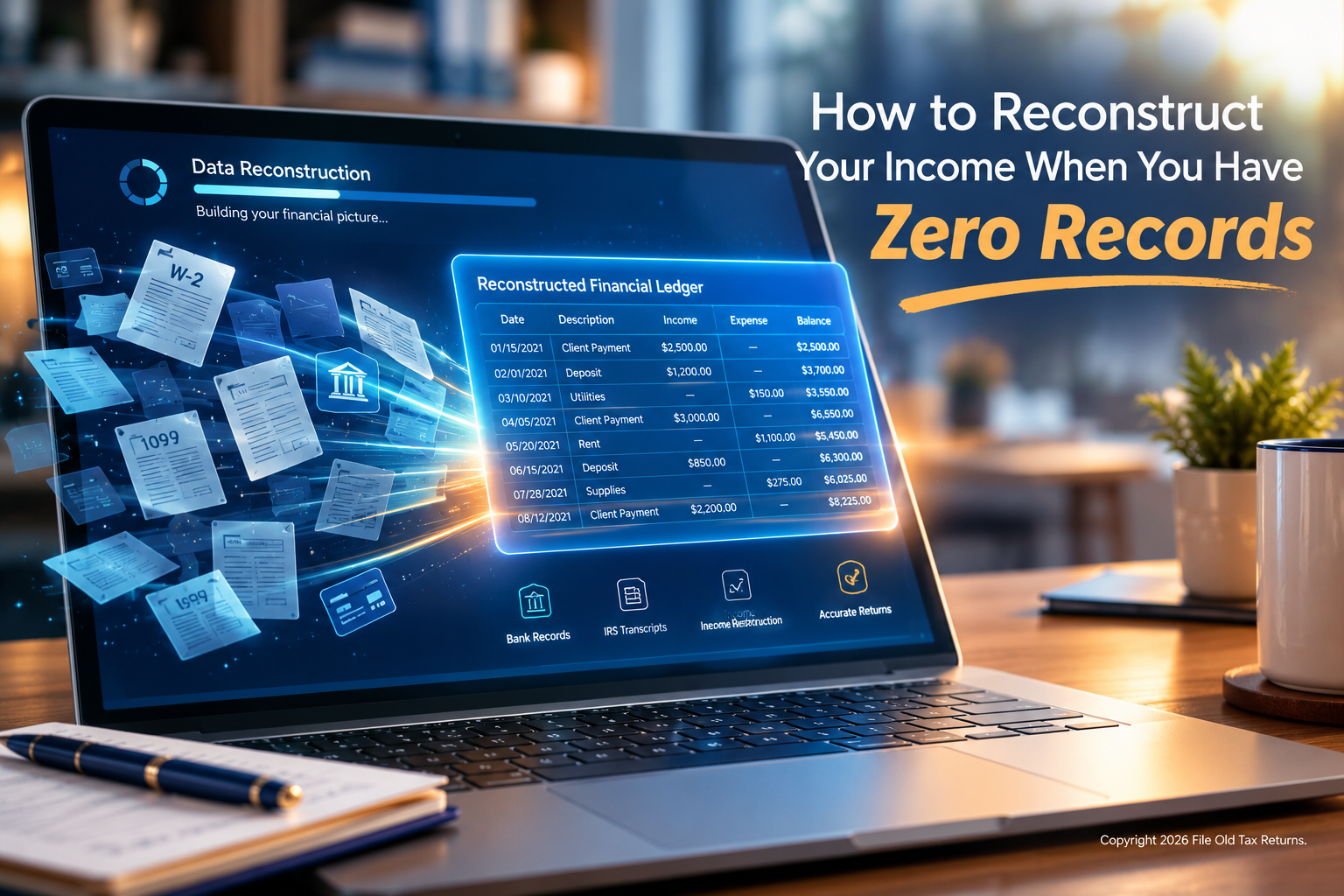
How to Reconstruct Your Income When You Have Zero Records

Picture this: You finally sit down to tackle that old tax return, determined to get everything caught up, only to realize you’re missing the paperwork you need. No W-2. No 1099. Not even a bank statement from that far back. Maybe the paperwork was lost during a move, misplaced over the years, or simply never saved in the first place. Sound familiar? You’re not alone. We hear this situation more often than you might think. The good news is that “no records” doesn’t mean “no return.” It simply means you may need to take a different approach to reconstructing your income and financial information. In this guide, we’ll walk you through the steps to help you piece together the information you need and get that old return filed.

Start With the IRS, They Probably Have More Than You Do

Here’s something a lot of people don’t realize, even if you lost every scrap of paper from that year, the IRS almost certainly didn’t. Every W-2, every Form 1099, every 1098 that was ever issued under your Social Security number was also sent to the IRS. That means your entire wage history is sitting in their system, waiting for you to request it.

The document you want is called a Wage and Income Transcript. It summarizes, line by line, every income document reported to the IRS under your SSN for a given tax year, W-2 wages, 1099-MISC and 1099-NEC payments, 1099-INT interest, 1099-DIV dividends, mortgage interest statements, and more. If you had it, someone reported it, and it’s on that transcript.

How to Actually Get Your Transcript

You’ve got two ways to request one:

  1. Online, instantly. Go to gov and use the Get Transcript tool to view and download your Wage and Income Transcript the same day. To use this option, you’ll need to create (or log into) an IRS Online Account, which requires identity verification through ID.me. Be ready to have a photo ID and your phone or a photo-capable device handy, the verification process will ask you to upload identification and, in some cases, take a quick selfie to confirm it’s really you.
  2. By mail. If you’d rather not (or can’t) verify your identity online, file Form 4506-T, Request for Transcript of Tax Return, and the IRS will mail your transcript to the address they have on file. This route is slower, plan on it taking several weeks, so if you have any flexibility, the online option will save you a lot of waiting.

One thing worth knowing up front: Wage and Income Transcripts are only available for the current tax year plus the prior 10 years. If you’re trying to reconstruct something older than that, this document won’t be available, and you’ll need to lean more heavily on the other methods below.

We put together a short video walking through exactly what these transcripts look like and how to make sense of them once you have one in hand, it’s worth a few minutes: Watch the video here.

What the Transcript Won’t Show You

As helpful as it is, a Wage and Income Transcript only tells you what was reported to the IRS. It won’t catch:

  • Cash income that was never reported by anyone
  • Self-employment or side-gig income under the reporting threshold
  • Tips that weren’t reported through an employer
  • Anything from a business that closed and never issued the required forms in the first place

For those situations, you’ll need to rebuild your numbers using other trails you left behind, which is exactly what the rest of this post covers.

Reconstructing Wage Income

If you were a W-2 employee and just can’t find the form itself, try these in order:

  1. Contact the employer directly. Payroll departments (if it was a smaller company, contact whoever handled payroll), typically keep copies for years and can reissue a W-2 or at least confirm the numbers.
  2. Pull the Wage and Income Transcript. As covered above, this is often faster than tracking down a former employer, especially one that’s since closed or been sold.
  3. Use your last pay stub and Form 4852. If neither option works and you’re up against a deadline, you can use your final pay stub of the year to estimate your wages and withholding, then file Form 4852, Substitute for Form W-2, in place of the missing document. Just know the IRS may take a little longer to process a return filed this way while they verify the numbers.

Reconstructing Self-Employment or Business Income

This is where things get more involved, because there’s often no third-party form to fall back on at all. If you were self-employed, freelancing, or running a small business during the year in question, here’s how we approach it:

1. Start With Your Bank and Credit Card Statements

Most banks will let you request statements going back several years, sometimes for a small fee. Deposits into your business (or personal, if you weren’t keeping them separate) account become your starting point for reconstructing gross income. Credit card and bank statements showing what you spent to run the business become your starting point for expenses.

2. Cross-Check Against Any 1099s on File With the IRS

Even if you never received a copy, a client who paid you $600 or more may have filed a 1099-NEC or 1099-MISC with the IRS anyway. Your Wage and Income Transcript will show these, so always pull it and compare it against what you’re reconstructing from your bank records.

3. Rebuild a Simple Profit and Loss Picture

Once you have deposits and expenses lined up by month, total them out. Take a step back and ask: does the resulting profit make sense against what you actually lived on that year (rent, groceries, utilities)? If the numbers show little to no profit but you were clearly paying your bills, that’s usually a sign some income is still missing from the reconstruction, and it’s exactly the kind of gap the IRS will also be looking for if they ever review the return.

4. Use Third-Party Records to Fill Remaining Gaps

  • Invoices or contracts you sent to clients
  • Payment platform records, PayPal, Venmo, Square, Stripe, etc.
  • Mileage logs, calendars, or appointment books that support what work was performed and when
  • Vendor or supplier statements showing what you purchased for the business

Don’t Forget Other Income Sources

While you’re pulling everything together, make sure you’re also accounting for:

  • Interest and dividend income (Form 1099-INT / 1099-DIV, your bank or brokerage can usually reissue these)
  • Rental income, along with the related expenses that offset it
  • Unemployment compensation, which is taxable and reported on Form 1099-G
  • Retirement account withdrawals, reported on Form 1099-R

Putting It All Together

Once you’ve gathered what you can from your Wage and Income Transcript, former employers, bank and card statements, and any other supporting records, you’ll have a reasonable, defensible picture of that year’s income, even without a single original document in hand. From there, it’s a matter of preparing the actual return, which you can do yourself using the transcript and reconstructed figures, or hand off to a professional who deals with exactly this kind of situation regularly.

You Don’t Have to Piece This Together Alone

We understand that catching up on several years of tax returns can feel overwhelming. The good news is, you don’t have to tackle it alone. At Wilson Rogers & Co., we help clients reconstruct missing tax information every day—from pulling IRS transcripts to rebuilding income and expenses from bank records and making sure prior-year returns are prepared accurately. If you’d rather leave the digging, organizing, and paperwork to a professional, we’d be happy to help you get caught up and move forward with confidence.

Go to Top