Get Your Free Download

5 Mistakes People Make When Filing Old Tax Returns!


We respect your email privacy

Get Your Free Download

5 Mistakes People Make When Filing Old Tax Returns!


We respect your email privacy

What Is an Offer in Compromise? Who Qualifies and How to Settle IRS Tax Debt

If you’ve ever seen a commercial promising to settle your tax debt for “pennies on the dollar,” you’ve already heard of an Offer in Compromise, just not the real version. The actual program is legitimate, it’s run directly by the IRS, and it genuinely helps people every year. It’s also a lot more selective than the ads make it sound. Let’s walk through what it actually is, who actually qualifies, and what the real odds look like.

How an IRS Offer in Compromise Works

An Offer in Compromise, or OIC, lets you settle your tax debt for less than the full amount you owe. The IRS isn’t doing you a favor out of kindness, they’re being practical. If the agency genuinely believes it will never collect the full balance from you, accepting a smaller amount now makes more sense than chasing an uncollectible debt for years.

There are three bases the IRS will consider:

  • Doubt as to Collectability: The most common type. You genuinely can’t pay the full amount, now or in the foreseeable future.
  • Doubt as to Liability: You have a legitimate dispute about whether you actually owe the amount assessed.
  • Effective Tax Administration: You could technically pay in full, but doing so would create a genuine economic hardship or would be unfair given your circumstances.

The Formula Behind the Decision: Reasonable Collection Potential

The IRS doesn’t just take your word for what you can afford. They calculate something called your Reasonable Collection Potential, or RCP, essentially your asset equity plus what they believe you can realistically pay from future income. Your offer has to meet or exceed that number. This is why two people with the same tax balance can get very different results, your RCP is based on your specific financial picture, not the amount you owe.

Who Actually Qualifies

Before the IRS will even consider your offer, you need to meet some basic requirements:

  • You’ve filed every tax return you’re required to file, no exceptions
  • You’re current on this year’s estimated tax payments
  • If you’re a business owner with employees, you’ve made your required payroll tax deposits for the current and two preceding quarters
  • You’re not in an open bankruptcy proceeding

Unfiled returns are, by far, the most common reason an offer never makes it off the ground. If you’re behind on filing, that must be fixed first.

What It Costs to Apply

Submitting an offer isn’t free. You’ll generally pay a $205 application fee, plus an initial payment toward your offer, either 20% of the offer amount upfront for a lump sum offer, or your first proposed installment if you’re paying overtime. Low-income taxpayers can qualify to have both the fee and the upfront payment waived.

The Honest Truth About Your Odds

Here’s the part those commercials skip. In fiscal year 2024, the IRS received 33,591 Offers in Compromise and accepted 7,199 of them, an acceptance rate of about 21.4%. That’s a steep drop from 2023, when roughly 42.1% of offers were accepted. Over the last decade, the average acceptance rate sits around 36%, so odds move around quite a bit year to year.

None of that means an OIC isn’t worth pursuing, it means a well-prepared, realistic offer matters enormously. A rushed or overly optimistic offer amount is one of the fastest ways to land in the rejected pile.

How to Get a Realistic Read Before You Apply

  1. Use the IRS’s free Offer in Compromise Pre-Qualifier Tool to get a preliminary estimate. It’s not a decision, but it will flag obvious disqualifying issues before you invest time in a full application.
  2. Get all outstanding returns filed first, this alone resolves a huge share of rejected applications.
  3. Complete Form 656 along with Form 433-A (OIC) for individuals or Form 433-B (OIC) for businesses, being thorough and accurate with your financial disclosures.
  4. Expect the review to take several months, sometimes up to a year, so plan your other collection options accordingly while you wait.

We Can Help You Figure Out Where You Stand

Don’t let tax debt stand in the way of your financial future. An Offer in Compromise can be a genuine lifeline, but it only works when the numbers are built correctly from the start. Understanding your options is the first step toward finding a path forward. Wilson Rogers & Co. can help you evaluate your financial situation, explore potential tax relief solutions, and determine the best next steps toward resolving your tax debt and achieving greater financial stability.
How to Reconstruct Your Income When You Have Zero Records

Picture this: You finally sit down to tackle that old tax return, determined to get everything caught up, only to realize you’re missing the paperwork you need. No W-2. No 1099. Not even a bank statement from that far back. Maybe the paperwork was lost during a move, misplaced over the years, or simply never saved in the first place. Sound familiar? You’re not alone. We hear this situation more often than you might think. The good news is that “no records” doesn’t mean “no return.” It simply means you may need to take a different approach to reconstructing your income and financial information. In this guide, we’ll walk you through the steps to help you piece together the information you need and get that old return filed.

Start With the IRS, They Probably Have More Than You Do

Here’s something a lot of people don’t realize, even if you lost every scrap of paper from that year, the IRS almost certainly didn’t. Every W-2, every Form 1099, every 1098 that was ever issued under your Social Security number was also sent to the IRS. That means your entire wage history is sitting in their system, waiting for you to request it.

The document you want is called a Wage and Income Transcript. It summarizes, line by line, every income document reported to the IRS under your SSN for a given tax year, W-2 wages, 1099-MISC and 1099-NEC payments, 1099-INT interest, 1099-DIV dividends, mortgage interest statements, and more. If you had it, someone reported it, and it’s on that transcript.

How to Actually Get Your Transcript

You’ve got two ways to request one:

  1. Online, instantly. Go to gov and use the Get Transcript tool to view and download your Wage and Income Transcript the same day. To use this option, you’ll need to create (or log into) an IRS Online Account, which requires identity verification through ID.me. Be ready to have a photo ID and your phone or a photo-capable device handy, the verification process will ask you to upload identification and, in some cases, take a quick selfie to confirm it’s really you.
  2. By mail. If you’d rather not (or can’t) verify your identity online, file Form 4506-T, Request for Transcript of Tax Return, and the IRS will mail your transcript to the address they have on file. This route is slower, plan on it taking several weeks, so if you have any flexibility, the online option will save you a lot of waiting.

One thing worth knowing up front: Wage and Income Transcripts are only available for the current tax year plus the prior 10 years. If you’re trying to reconstruct something older than that, this document won’t be available, and you’ll need to lean more heavily on the other methods below.

We put together a short video walking through exactly what these transcripts look like and how to make sense of them once you have one in hand, it’s worth a few minutes: Watch the video here.

What the Transcript Won’t Show You

As helpful as it is, a Wage and Income Transcript only tells you what was reported to the IRS. It won’t catch:

  • Cash income that was never reported by anyone
  • Self-employment or side-gig income under the reporting threshold
  • Tips that weren’t reported through an employer
  • Anything from a business that closed and never issued the required forms in the first place

For those situations, you’ll need to rebuild your numbers using other trails you left behind, which is exactly what the rest of this post covers.

Reconstructing Wage Income

If you were a W-2 employee and just can’t find the form itself, try these in order:

  1. Contact the employer directly. Payroll departments (if it was a smaller company, contact whoever handled payroll), typically keep copies for years and can reissue a W-2 or at least confirm the numbers.
  2. Pull the Wage and Income Transcript. As covered above, this is often faster than tracking down a former employer, especially one that’s since closed or been sold.
  3. Use your last pay stub and Form 4852. If neither option works and you’re up against a deadline, you can use your final pay stub of the year to estimate your wages and withholding, then file Form 4852, Substitute for Form W-2, in place of the missing document. Just know the IRS may take a little longer to process a return filed this way while they verify the numbers.

Reconstructing Self-Employment or Business Income

This is where things get more involved, because there’s often no third-party form to fall back on at all. If you were self-employed, freelancing, or running a small business during the year in question, here’s how we approach it:

1. Start With Your Bank and Credit Card Statements

Most banks will let you request statements going back several years, sometimes for a small fee. Deposits into your business (or personal, if you weren’t keeping them separate) account become your starting point for reconstructing gross income. Credit card and bank statements showing what you spent to run the business become your starting point for expenses.

2. Cross-Check Against Any 1099s on File With the IRS

Even if you never received a copy, a client who paid you $600 or more may have filed a 1099-NEC or 1099-MISC with the IRS anyway. Your Wage and Income Transcript will show these, so always pull it and compare it against what you’re reconstructing from your bank records.

3. Rebuild a Simple Profit and Loss Picture

Once you have deposits and expenses lined up by month, total them out. Take a step back and ask: does the resulting profit make sense against what you actually lived on that year (rent, groceries, utilities)? If the numbers show little to no profit but you were clearly paying your bills, that’s usually a sign some income is still missing from the reconstruction, and it’s exactly the kind of gap the IRS will also be looking for if they ever review the return.

4. Use Third-Party Records to Fill Remaining Gaps

  • Invoices or contracts you sent to clients
  • Payment platform records, PayPal, Venmo, Square, Stripe, etc.
  • Mileage logs, calendars, or appointment books that support what work was performed and when
  • Vendor or supplier statements showing what you purchased for the business

Don’t Forget Other Income Sources

While you’re pulling everything together, make sure you’re also accounting for:

  • Interest and dividend income (Form 1099-INT / 1099-DIV, your bank or brokerage can usually reissue these)
  • Rental income, along with the related expenses that offset it
  • Unemployment compensation, which is taxable and reported on Form 1099-G
  • Retirement account withdrawals, reported on Form 1099-R

Putting It All Together

Once you’ve gathered what you can from your Wage and Income Transcript, former employers, bank and card statements, and any other supporting records, you’ll have a reasonable, defensible picture of that year’s income, even without a single original document in hand. From there, it’s a matter of preparing the actual return, which you can do yourself using the transcript and reconstructed figures, or hand off to a professional who deals with exactly this kind of situation regularly.

You Don’t Have to Piece This Together Alone

We understand that catching up on several years of tax returns can feel overwhelming. The good news is, you don’t have to tackle it alone. At Wilson Rogers & Co., we help clients reconstruct missing tax information every day—from pulling IRS transcripts to rebuilding income and expenses from bank records and making sure prior-year returns are prepared accurately. If you’d rather leave the digging, organizing, and paperwork to a professional, we’d be happy to help you get caught up and move forward with confidence.

Join Our FREE Monthly Tax Debt Webinar!

Join us for our FREE Webinar!

Are you ready to put your back tax problems behind you?  Fighting back against the IRS or state department of revenue requires a plan.  Let us give you that plan…for FREE!

Many tax relief companies advertise help for taxpayers in distress — in exchange for an upfront fee, which can be thousands of dollars.   In many cases, these companies don’t settle your tax debt. Some don’t even send your paperwork to the IRS to apply for programs to help you. These companies often leave people even further in debt.

But if you owe back taxes and don’t know how you’re going to pay your debt, then we’ve got news for you! Join us for our next FREE webinar “10 Ways To Settle IRS & State Tax Debt” which is being held on Thursday June 15th 2023 at Noon CST.

We plan to hold these webinars monthly so if you’re reading this after June 15th, still click the link below.  If another webinar is planned, the page will be updated to show you the date of the next scheduled webinar.

Upon sign up, you will immediately receive instructions on how to join to the webinar, as well as our special report “5 Questions To Ask Any Tax Resolution Firm BEFORE Paying Them A Dime.”

ALL attendees will be eligible to receive a comprehensive 30-minute Tax Debt Settlement Analysis and personalized Tax Resolution Plan. This plan is regularly $175, but FREE to all attendees, so act NOW!

To learn more visit www.solvemytaxmess.com and then sign up.  Space is always limited so don’t miss your chance to attend this exclusive event!

How to File Back Taxes – A Step By Step Guide

We’re pleased to announce the release of our new course – click image to learn more!

We know we’ve been “ghost” for a little while and all we can say is that a lot has happened during the period that we were all dealing with Covid-19. Part of what happened is we were in the Bat Cave deep in work. And today we have a very special announcement to make!

You see, this website is one of several that are operated by Wilson Rogers & Company.  They are a financial services company based in Chicago that offer tax and other related products to the public.  Well, as part of the launch of their new financial management site, Make My Money Make Sense, they have decided to offer courses.  The first course to be launched?  How to File Back Taxes – A Step By Step Guide.

This course is an expansion of their most viewed YouTube video (see below) How To File Back Tax Returns | TCC and will teach:

  • Those who have back taxes and are looking for a course how to solve them via a DIY method or,
  • Tax professionals who want to learn the nuances of filing back tax returns so they can either solve their client’s problems OR learn how to add this valuable service offering to their product line up.

To celebrate, from now until 11:30PM CST on December 31st 2022, customers can get it for 50% off the $97 normal price. To claim the discount use the coupon code “HOLIDAY50” at checkout (case sensitive). If you have any issues using the code just contact us via the email or phone number in the footer of this post.

To purchase the course or learn more you can visit the course and products page on the Make My Money Make Sense website or go straight to the sales page.

Stimulus Check: When Is The Deadline To Claim?

The Coronavirus Aid, Relief, and Economic Security Act (CARES Act) authorized the IRS to issue Economic Impact Payments (aka stimulus payment/check) of up to $1,200 to most U.S. citizens and residents.  However, time is running out to claim those funds.  Here, we discuss what you need to know.

Who is eligible for a stimulus payment under the CARES Act?

You’re likely eligible for a stimulus payment if you:

  1. are a U.S. citizen or resident alien
  2. have a work-eligible Social Security number, and
  3. can’t be claimed as a dependent on someone else’s tax return.

How large is the stimulus payment?
The CARES Act authorized payments of up to $1,200 to eligible individuals plus $500 per qualifying child, and up to $2,400 to married couples who file a joint return plus $500 per qualifying child.

What are the deadlines to claim your stimulus payment?
The answer to that question depends on if you were required to file a return or not.  Generally, those who meet the requirements below would NOT have been required to file a return:

  • Your income is less than $12,200
  • You’re married filing jointly and together your income is less than $24,400
  • You have no income

If you were not required to file a 2019 federal income tax return, the best and fastest way to claim your stimulus payment is to visit the IRS EIP page by October 15th 2020, and click “Non-Filers: Enter Payment Info Here.” If you provide bank account information, the IRS will deposit a payment directly into your account. If you don’t provide bank account information, they’ll mail you a check.

If you were required to file a 2019 federal income tax return, the best and fastest way to claim your stimulus payment is to electronically file your 2019 tax return immediately. If you already filed a 2019 tax return, you can check the status of your stimulus payment by visiting the same IRS EIP page provided above and clicking “Get My Payment.”

After October 15th 2020, the only way to claim your stimulus payment will be to file a federal income tax return. If you do not file a 2019 tax return in 2020, you may instead be able to claim a recovery rebate credit when you file your 2020 federal income tax return in 2021.

Best Time To File Old Taxes? NOW!

Believe it or not, the percentage of the taxpaying population who files late or doesn’t file at all is substantial.  There have been several statistics that indicate that eleven to fourteen million taxpayers fail to file their returns on time.  This could mean they do it months, if not years after the April 15th deadline.  The reasons for filing late are all across the board.  They range from forgetfulness and confusion on what to do to, all the way up to not sure how to pay a balance, to destruction of records.  No matter what the reason, we’re going to discuss why now (through say 2021) is the best time to file those old tax returns you’ve been putting off.

Covid-19 has slowed down IRS operations and processing times.  When the Internal Revenue Service (IRS) machine is humming along in a “normal” year, its computers are busy spitting out letters to taxpayers, and its personnel attempt to collect tax debt from delinquent taxpayers.  This includes audits, site visits, revenue officer contact and a host of other things.  The IRS is not “fast” in the best of times and now, due to Covid-19, their operations are severely impacted.  For example, from March through July 2020, the IRS computers were offline and NO mail sent to the IRS was opened.  All of the above can give you “more” time to address your situation.  Meaning, it can give you time to:

  • Get the documents needed to have the old tax returns prepared.
  • Allow you to prepare all the returns at once for submission.
  • Determine if (or how much) you owe the IRS and come up with a game plan to deal with it.
  • Mail or electronically file the returns with the IRS and then wait for them to catch up and respond.

If you only filed a 2018/2019 tax return for a stimulus check, but have other unfiled returns, you just put yourself back on the IRS’ radar.  Those who filed tax returns but have other unfiled tax returns, just “raised their hand” so-to-speak with the IRS.  Essentially, that person has now told the IRS 1) that they are still around and 2) where to send the letter asking about those other unfiled years.  It’s only going to be a matter of time before they reach out to you about those missing returns.  Best to use this time to perform the steps outlined in the bullet points above!

If you owe the IRS, the sooner you file, the sooner the 10 year clock for them to collect starts running.  Many taxpayers, and some practitioners, are unaware that the IRS by law only has 10 years’ time to collect a tax debt. This is referred to as the statute of limitations or in IRS speak, the Collection Statute Expiration Date or CSED for short. The 10-year period begins to run with the date of the “assessment” of the tax, not the tax year for which taxes are due. For example, if a return for 2017 is not filed until 2020 and the tax is assessed in 2020, the 10-year period begins to run in 2020 and expires in 2030.

If you’re not working or have a reduced income due to Covid-19, it could result in a “deal” with regards to your tax debt.  When it comes to settling ones tax debt, it all comes down to the IRS term referred to as reasonable collection potential or RCP.  The RCP is how the IRS measures the taxpayer’s ability to pay on the taxes they owe.  It includes the value that can be realized from the taxpayer’s assets, such as real property, automobiles, bank accounts, and other property. The RCP also includes anticipated future income, less certain amounts allowed for basic living expenses.  It is the last point that can get you a deal during these “unprecedented times” we will be facing until about 2021.

You see, if you have no assets and your income is reduced, your RCP could be $0 or even negative once the IRS factors in those allowable expenses.  If your RCP is in fact $0, then that means that you won’t have to pay them anything (at the moment).  Why?  Because the IRS will place your account into Currently Not Collectible (CNC) status.  But what is also good about not having income coming in at this time is that you may be able to settle all your tax debt via an Offer In Compromise (OIC).  The OIC program allows eligible tax debtors to pay the IRS an amount of money that is less than what they owe in order to wipe out their entire tax liability.

Now is the perfect time to “reset” your life and taxes.  Covid-19 will force some people to hit “rock bottom” so to speak.  But this is the best time to reset your life, get rid of the past and move forward.  Why?

  • When you hit rock bottom, you let go of everything. You start again with nothing and get rid of all the stuff in your life that doesn’t make sense.
  • Pain is the momentum and the motivation you’ve probably needed to make you actually deal with your tax situation once and for all.
  • Rock bottom is where your gratitude increases ten times, if not more. That’s because life is a battle and it’s not easy.  It’s not meant to be a walk in the park, but it can be so much better when you appreciate all that is around you.

Need help filing those old tax returns?  Why not make today the day you FINALLY deal with those old tax returns?  Why not take the first step to getting that IRS monkey off your back?  Take the first step RIGHT NOW and call our office or shoot us an email via the signature in our footer.  We can help you get any missing documents, file your returns and even deal with the IRS debt should you owe back taxes.  Trust us, you’ll feel much better once you put this behind you!

IRS CSEDs Are Sometimes Inaccurate


The Collection Statute Expiration Date (CSED) ends the Government’s right to pursue collection of a tax liability.  This date is generally 10 years from the date the tax was assessed.  However, some situations require the CSED to be recalculated.  In a 2013 audit by the Treasury Inspector General for Tax Administration (TIGTA), it was determined that the CSED was not always recalculated accurately.  An inaccurately calculated CSED could result in unlawful collection activity by the IRS and violate a taxpayer’s rights.  Conversely, the IRS could potentially lose revenue if an inaccurate CSED appears to have expired when the debt is still collectible.

Why TIGTA Did The Audit?

Over the years, the IRS has taken steps in an attempt to improve CSED accuracy. However, the National Taxpayer Advocate has reported miscalculated CSEDs as one of the most serious problems encountered by taxpayers. TIGTA’s audit was initiated to determine whether CSED recalculations were properly and accurately completed to effectively protect taxpayers’ rights and the Government’s interest.

What The Report Found.

TIGTA did a statistical sample of 75 tax modules from a population of 1,085 with manually recalculated CSEDs.  What they found was that 29 of the 75 tax modules, or roughly 40%, contained errors.  Their specific findings were:

  • Twenty-one had inaccurate CSEDs and eight were missing the required documentation to support the CSEDs.

  • Based on the results of their case review, it was estimated that CSEDs for 260 tax modules were extended longer than they should have been, 43 tax modules were not extended as long as they should have been, and 116 tax modules were unverifiable.

  • Most errors were made by employees.  Managerial approval is required when CSEDs are extended or updated for any reason.  However, the IRS internal controls requiring managerial approval were not always effective in ensuring the accuracy of manually recalculated CSEDs.

  • An IRS computer system recalculates most CSEDs systemically.  Random samples from eight separate activities that trigger systemic CSED recalculations showed that all CSEDs were accurate for six of the eight activities.  However, the CSED recalculations were not always accurate for modules involving bankruptcies or estates.

  • TIGTA also identified nine taxpayers who received an annual balance due reminder notice after the CSED expired.

What does this all mean?

If you have IRS debt that you believe has expired, but you are still receiving notices about it, then it could mean one of two things:

  1. Your CSED was inaccurately calculated
  2. There were actions taken on your account that stopped or “tolled” the CSED.

This post discusses what tolls the CSED and for how long.  If you are looking for how to calculate or recalculate your CSED, we recommend this post from our sister site.  It talks about how we offer a service, for a nominal price, where your CSED can be calculated so you know approximately when your CSED will expire.

Deadline Extended to Claim Refunds for 2016 Tax Returns

Time is running out to file your 2016 tax return!

If you did not file a tax return for 2016, you may be one of over 1 million taxpayers who may be due a refund from that year.  The deadline for you to claim a refund, on a tax return in which one was owed to you, is 3 years from its due date (including extensions).  For example, if you were due a refund on your 2016 Income Tax Return (which was due April 15th 2017), you would have until April 15th 2020 to claim it.  If you don’t file a claim for a refund within three years, the money becomes property of the U.S. Treasury!

Due to the Covid-19 pandemic, the IRS has extended the time to claim refunds related to 2016 until July 15th 2020.

Note, there is no interest or penalty for failing to file a return in which a refund was owed.  However, if you have a balance due, those items can be pretty stiff as outlined in this post.

Here are some of the facts you need to know about 2016 unclaimed refunds:

  • The unclaimed refunds apply to those who didn’t file a federal income tax return for 2016.
  • Some people, such as students, part-time workers or seasonal employees may not have filed because they thought they had too little income to require filing a tax return. However, if you did not have a filing requirement, you may still have a refund waiting if you had taxes withheld from your wages.  A refund could also apply if a taxpayer qualified for certain tax credits, such as the Earned Income Tax Credit.
  • The law requires that you properly address, mail and postmark your tax return by July 15th 2016 to claim your refund.  2016 returns CAN NOT be e-filed as they are not one of the 3 active years currently supported by the IRS Modernized E-File (MEF) system.
  • The IRS may hold your 2016 refund if you have not filed tax returns for 2017 and 2018. The U.S. Treasury will apply the refund to any federal or state tax you owe. It also may use your refund to offset unpaid child support or past due federal debts such as student loans.
  • If you’re missing Forms W-2, 1098, 1099 or 5498 for 2016, you should ask for copies from your employer, bank or other payer. If you can’t get copies, get a free transcript showing that information by going to IRS.gov. You can also file Form 4506-T to get a transcript.

Need help filing that 2016 tax return?  Give us a call or visit the main page of our site and shoot us an email via the address in the footer.  We have the software to file tax returns going all the way back to 2002 so we’re sure we can help you out with 2016!

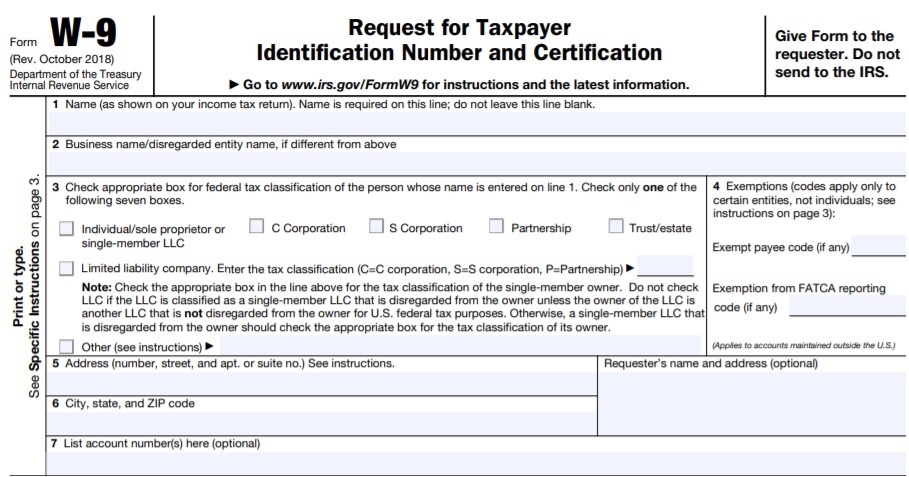
How To Fill Out IRS Form W-9

A W-9 is used to confirm a person’s name, address, and taxpayer identification number (TIN) for employment or other income-generating purposes


IRS Form W-9 is officially titled the Request for Taxpayer Identification Number and Certification.  This form is used to provide the correct Taxpayer Identification Number (TIN) to a person (or company) that is required to file an information return with the IRS.  This information return (e.g. Form 1099-MISC, Form 1098) is to report, for example:

  • Non-employee compensation;
  • real estate transactions;
  • mortgage interest;
  • acquisition or abandonment of secured property;
  • cancellation of debt;
  • and contributions to an IRA.

Now let’s look at the exact steps to correctly complete a Form W-9.

Line 1 of the form asks for your name. If you’re running a sole proprietorship you would enter YOUR name.  To clarify this point, the name on line 1 must match with the name the IRS associates with your TIN (i.e SSN or EIN).  The name on line 1 should never be a disregarded entity – a single owner LLC.

If you have a business name, trade name, doing business as name or disregarded entity name you can enter it on line 2 business name.

On line 3, select just ONE box. Check the appropriate box for the U.S. federal tax classification of the person whose name is entered on line 1.  For example, let’s say that Jared Rogers is the name on line 1.  However, Jared owns and does business as Jared’s Dirty Little Secret LLC.  Since the LLC is owned only by Jared, he would check the “Individual/sole proprietor or single-member LLC” box on line 3.  By contrast, of the LLC was owned by 2 people, then the would check the “Limited liability company” box and enter in P (for Partnership) in the box to the right.

Line 4 is for exemption codes. Exemption codes are for those payments that are exempt from backup withholding.  Usually, individuals aren’t exempt from backup withholding. Corporations are exempt from backup withholding for certain payments.  Refer to the instructions provided with Form W-9 for the appropriate code to use if you believe your business is exempt from potential backup withholding.

In line 5, enter your address. If you have already provided the requester an address and this is a new address write “new” at the top.  If you discover that the requester has been using the wrong address or TIN for your business, let the requester know as soon as possible and provide the correct information.

Enter your city, state and zip in line 6.  Line 7 is optional. Some businesses have multiple accounts with a vendor and this line is available to specify which account this W-9   pertains to.

You’ll complete Part I next. Enter your SSN, EIN or individual taxpayer identification as appropriate.   If you’re asked to complete Form W-9 but don’t have a TIN, apply for one and write “Applied For” in the space for the TIN, sign and date the form, and give it to the requester.  Requestors of Form W-9 will have to deduct backup withholding from any payments that are subject to it until you provide your TIN.

Next, you’ll complete Part II. This is where you sign when required.  Form W-9 is officially titled Request for Taxpayer Identification Number and Certification. By signing it you attest that:

  • The TIN you gave is correct. This can be a Social Security number or the employer identification number (EIN) for a business.
  • The taxpayer (you, the payee) isn’t subject to backup withholding.
  • You’re a U.S. citizen or other U.S. person.
  • Any FATCA (Foreign Account Tax Compliance Act) codes on the form are correct. FATCA reports are required of U.S. citizens to report foreign financial assets held outside the U.S. ​
  • If you’re a recipient of payments that are reported in Box 5 or Box 7 for nonemployee compensation on Form 1099-MISC you must give your correct TIN. You must sign the certification if you’ve been notified that the previously provided TIN is incorrect, or there is a problem with the information provided to the IRS at an earlier date.

Although Form W-9 is a standard tax document and by itself, it doesn’t pose many problems, there are a few situations worth watching for.

  • Make sure a person knowledgeable about your business is filling out the form.
  • If you’re starting a new job and your employer hands you a W-9, ask if you’ll be working as a self-employed independent contractor or as an employee. Employees complete Forms W-4, not Forms W-9, to set their tax withholdings.
  • Make sure you understand and agree with the worker classification the requestor has in mind.
  • If you’re unsure why you’re being asked to complete the form, ask what types of tax documents you can expect to receive when the information is used. Form 1099-Miscellaneous, for example or Form 1099-DIV.
  • Make sure the person taking your information is authorized to do so.

You should always exercise caution when giving out sensitive information like your name, address, SSN or EIN so take steps to transmit W-9 information securely.  Protect the confidential information by sending it via an encrypted email, by hand delivery, or by mail.

You might have other questions as you complete a Form W-9.  With that said, it’s advisable to download the instructions and review them prior to completing and submitting the form to the requestor.

Go to Top