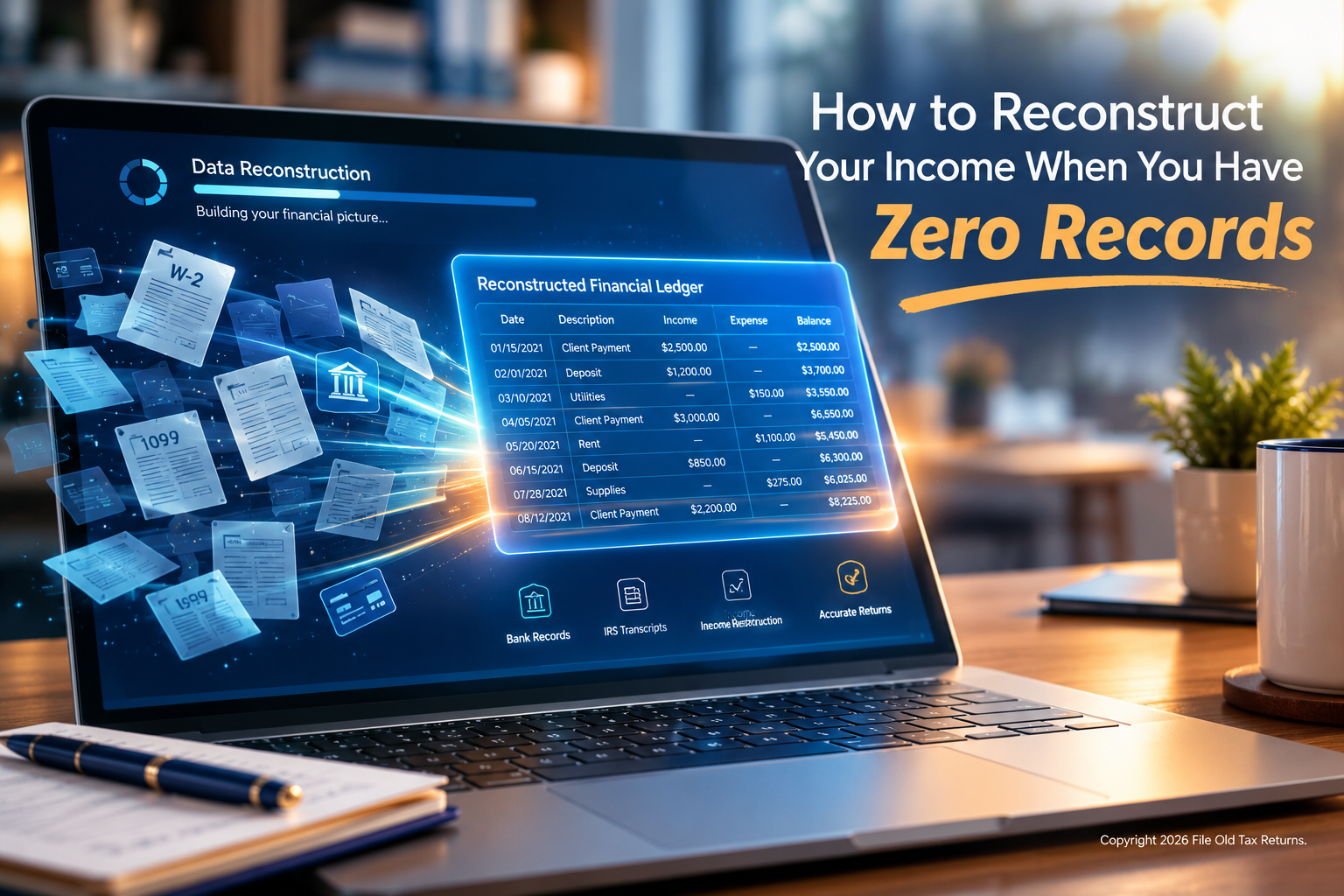
Why You Need a Wage and Income Transcript Before Filing Old Tax Returns
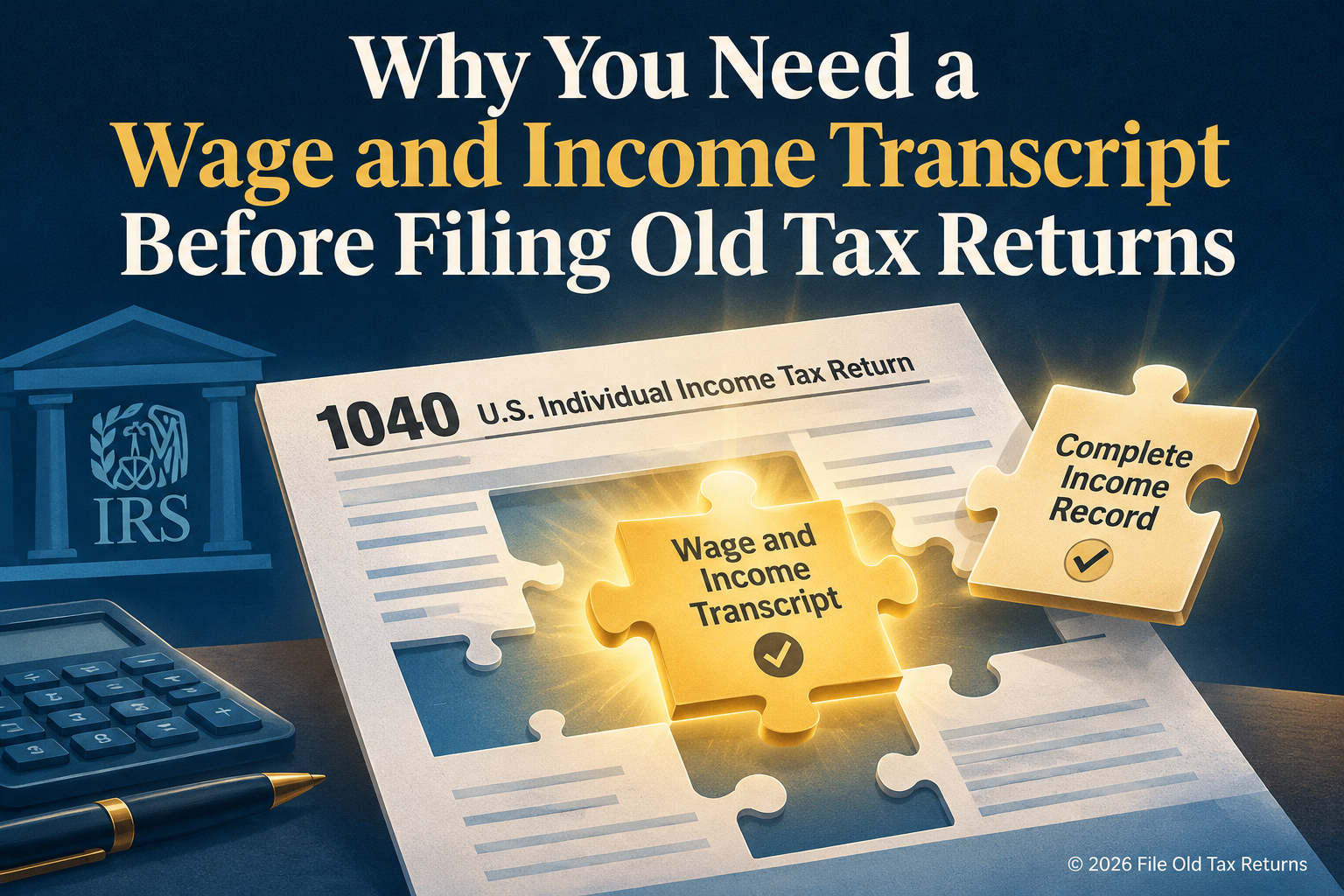
Why You Need a Wage and Income Transcript Before Filing Old Tax Returns
Filing old tax returns without all your tax documents can lead to missing income, incorrect information, and potential problems with the IRS. This is especially common if you changed jobs, worked for multiple employers, or haven’t filed taxes in several years.
If you’re missing W-2s, 1099s, or other important tax documents, don’t guess at the numbers or assume you have everything you need.
The IRS provides a helpful resource called a Wage and Income Transcript that can help you identify income reported under your Social Security number. Reviewing this transcript before preparing your tax returns can help you account for income the IRS already knows about and reduce the risk of filing incomplete or inaccurate returns.
Whether you’re filing this year’s return or catching up on several years of unfiled taxes, obtaining your Wage and Income Transcript should be one of your first steps.
What Is an IRS Wage and Income Transcript?
An IRS Wage and Income Transcript summarizes information reported to the IRS by employers, banks, financial institutions, and other third parties.
It may include information from:
- Form W-2: Wages and federal income tax withholding.
- Form 1099-NEC: Nonemployee compensation.
- Form 1099-MISC: Certain miscellaneous income.
- Form 1099-INT: Interest income.
- Form 1099-DIV: Dividend income.
- Form 1099-R: Retirement distributions.
- Form 1098: Mortgage interest information.
- Form 1098-T: Tuition information.
Essentially, it provides a consolidated view of information returns the IRS has received for a particular tax year.
This is especially helpful if you no longer have your original tax documents. Instead of relying on memory or incomplete records, you can review information reported directly to the IRS.
Why You Need a Wage and Income Transcript Before Filing
One of the biggest mistakes taxpayers can make is preparing a tax return using only the documents they currently have available.
Your Wage and Income Transcript provides an additional way to verify reported income before submitting your return.
Here are five reasons why it matters.
- Identify Missing Income
It is easy to overlook income, especially if you worked multiple jobs, changed employers, or received payments from different sources.
Your transcript can help identify W-2s, 1099s, retirement distributions, interest income, and other third-party reported information.
For example, suppose you worked for three different employers during the year but only received two W-2s. Your transcript may show that a third employer reported wages under your Social Security number.
Without reviewing the transcript, you could accidentally leave that income off your return.
- Avoid IRS Income Discrepancies
The IRS receives copies of many W-2s and 1099s directly from employers and financial institutions.
If your return does not account for income reported on those forms, the IRS may identify a discrepancy and send a notice requesting an explanation or proposing an adjustment.
Reviewing your transcript before filing gives you an opportunity to identify missing income and investigate potential differences before submitting your return.
- Verify Your Tax Documents Are Complete
Even if you have most of your tax documents, you may not have everything.
Your transcript provides another way to cross-check your records, particularly if you:
- Changed jobs during the year.
- Worked for multiple employers.
- Had retirement or investment accounts.
- Received income from multiple financial institutions.
- Lost access to an old payroll or financial account.
Think of your transcript as an additional verification step before filing.
- Reconstruct Income for Previous Tax Years
If you haven’t filed taxes in several years, locating every W-2 and 1099 can be difficult.
Former employers may have closed, payroll accounts may no longer be accessible, and financial institutions may not have older documents readily available.
Your Wage and Income Transcript can help reconstruct income information for the years you need to file.
Instead of trying to remember every employer or financial institution, you can use IRS records as a starting point for gathering the information needed to prepare your outstanding returns.
- Reduce the Risk of Filing an Incomplete Return
A tax return should account for all applicable income, not just the documents you happen to have on hand.
Reviewing your transcript helps you and your tax preparer identify additional information that needs to be investigated.
Taking this extra step can help reduce filing errors, avoid unnecessary IRS correspondence, and make the filing process smoother.
How Far Back Can You Get a Wage and Income Transcript?
The IRS generally makes Wage and Income Transcripts available for the current tax year and nine prior tax years.
For example, in 2026, taxpayers can generally access information for tax years 2017 through 2026, depending on processing and availability.
Keep in mind:
- Current-year information may not be complete immediately because employers and other payers submit information returns on different schedules.
- Older information may no longer be available through the IRS online transcript system.
- You may need to contact former employers, banks, or financial institutions directly for older records.
If you are filing multiple years of back taxes, request the available transcript for each year you need to address.
How to Get Your Wage and Income Transcript
There are three ways to obtain your transcript.
Option 1: Request It Online
The IRS Individual Online Account is generally the quickest way to access available transcripts.
- Visit IRS.gov.
- Sign in or create an Individual Online Account.
- Complete the required identity verification.
- Navigate to your tax records and transcripts.
- Select Wage and Income Transcript.
- Choose the applicable tax year and download the document.
Option 2: Submit Form 4506-T
If you cannot access your transcript online, you can submit Form 4506-T, Request for Transcript of Tax Return.
Follow the form instructions and select the appropriate transcript type and tax year.
Option 3: Work With a Tax Professional
An authorized tax professional may be able to obtain your Wage and Income Transcript through IRS practitioner systems.
Depending on the assistance needed, authorization may involve:
- Form 2848: Power of Attorney and Declaration of Representative.
- Form 8821: Tax Information Authorization.
A tax professional can help obtain multiple years of transcripts, review reported income, identify missing documents, and determine what additional records are needed before preparing your returns.
What a Wage and Income Transcript Does Not Show
Although a Wage and Income Transcript is an important resource, it has limitations.
It does not show every source of income. Cash payments, certain self-employment income, and other income not reported through third-party information returns may not appear. You are still responsible for reporting all taxable income.
It does not show all deductions or credits. You may need receipts, expense records, and other documentation to establish eligibility.
It does not include state and local withholding information. You may need original W-2s or employer records when preparing your state income tax return.
It is not a replacement for original tax documents. If you need an actual copy of a W-2 or 1099, contact the employer or payer that issued it.
What If Your Transcript Shows Missing or Incorrect Information?
Sometimes the information on your transcript may not match your personal records.
An employer may have submitted incorrect information, a payer may have issued a corrected 1099, or a document may not have been processed by the IRS yet.
If you notice a discrepancy:
- Contact the employer or payer for the original or corrected document.
- Compare the information against bank statements, payroll records, and other financial documents.
- Determine whether updated information was submitted to the IRS.
- Consult a tax professional if you need help reconciling the differences.
Do not automatically assume that everything on your transcript is correct or that it includes all your income.
Using Wage and Income Transcripts to File Back Taxes
If you have multiple years of unfiled tax returns, obtaining your Wage and Income Transcripts is an important first step.
Consider following this process:
- Step 1: Identify Your Unfiled Tax Years. Make a list of the years you believe you have not filed.
- Step 2: Request Your Wage and Income Transcripts. Obtain the available transcript for each applicable year.
- Step 3: Gather Additional Financial Records. Collect bank statements, business income and expense records, receipts, invoices, and any missing tax documents.
- Step 4: Review Your Filing Requirements. Filing requirements, deductions, credits, and tax laws can change from year to year. Each return must be evaluated using the rules applicable to that particular tax year.
- Step 5: Prepare and File Your Missing Returns. Once the necessary information has been gathered and reviewed, you can begin preparing your outstanding returns. If you owe taxes, filing can help determine your balance and allow you to evaluate available payment options.
Remember, your Wage and Income Transcript is a starting point. It should be reviewed alongside your other financial records to help ensure your returns account for all applicable income.
Final Thoughts
Before filing your tax returns, take the time to review your Wage and Income Transcripts. Missing a W-2, overlooking a 1099, or failing to account for income reported to the IRS can create unnecessary complications.
Whether you are missing documents for one tax year or trying to catch up on several years of unfiled returns, your transcript can help you identify reported income, uncover missing information, and prepare more complete returns.
Don’t let missing paperwork keep you from getting back on track.
File Old Tax Returns can help you take the next step toward getting caught up. Visit FileOldTaxReturns.com to learn more about getting your back taxes filed.